"All you need is love, but a little chocolate now and then doesn't hurt."

"All you need is love, but a little chocolate now and then doesn't hurt."
Showing posts with label movie. Show all posts

Sunday, October 19, 2014

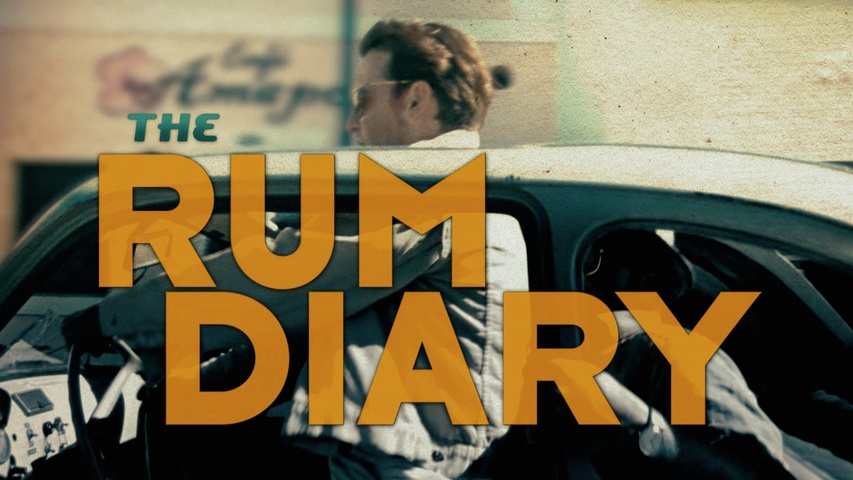
The Rum Diary


The film The Rum Diary is based on a book written by Hunter S. Thompson. The movie was directed by Bruce Robinson and was filmed in Puerto Rico. American actor Johnny Depp  interpreted an American journalist called Paul Kemp who hasn't been successful in the United States and started working for the San Juan Star newspaper in our island during the 1960s. 

The Rum Diary is similar to the Jamaica Kincaid's novel A Small Place. Jamaica Kincaid attacked the tourists in a way the reader can assume the tourist's role and felt offended by her writing. Paul Kemp arrived to Puerto Rico without any knowledge about the island. Kincaid said about this: "A tourist is an ugly human being." And why not? At first, he didn't know anything about our culture, the Puerto Rican lifestyle or even the economic status. He was an outsider who was hired to write about horoscopes until he faced the reality of Puerto Rico and started caring about the problems in the island after relating with Sala. Kemp became more interested in the situations of the island: poverty, alcoholism, ignorance, etc. 

Kemp changed throughout the movie. His transition can be defined with two scenes. The first was at the beginning of the movie. The taxi driver asked him something in Spanish and he replied he don't speak Spanish. This is a clear example of his outsider (tourist) view. The second scene is the one at the bowling alley. Kemp asked a tourist: "What you like most of Puerto Rico?"  The tourist replied: “The bowling alley and the casinos." Kemp asked him: "Have you seen a lot of the island?".  The tourist's  wife replied: “We never leave the hotel. It is not safe”.  His last question was: “But you are having fun, right? The woman replied: “Oh yeah, lots of fun! “. Here is Kincaid's voice: "The tourist is an ugly human being." After that, he wanted to write about the issues of Puerto Rico and he can be seen as an insider or partially insider (traveler). 

At the end of the movie, Kemp went back to the United States and became a successful writer. It is also a transition from an unsuccessful to a successful journey. It was a change of his perspective toward Puerto Rico and its locals. Kemp was able to understand the issue's location of the Puerto Ricans and sympathize with them in a good way.


Sunday, September 14, 2014

Dead Poets Society

Dead Poets Society shows the story of a group of students at Welton Academy that are influenced in some way by their new professor of English Literature, Mr. John Keating. Some of the students experienced changes in both their internal and external journeys proving that Carpe Diem is something extraordinary. "Seize the day": it's all about it. It's what Carpe Diem is about. Tradition, honor, discipline, and excellence. These were the four pillars that rules the lives of the students at the Academy and the ones they had to overcome by thinking for their own and achieving what they most want to. Throughout the movie, Neil Perry and Todd Anderson are the ones who changes at most.

Neil loves acting, but his father wants him to become a doctor because he has opportunities that he never had at his age. Mr. Perry seems to be a strict, demanding, and serious man who rules the life of his son at all aspects.  As the movie starts, Mr. Perry ordered Neil to quit from an extracurricular activity and Neil didn't have any option instead of followed his father's instructions.  Once Mr. Keating started teaching at the Academy, Neil proposed his friends to make the Dead Poets Society. He started to see the world from other point of view. This is when his internal journey starts to be revealed. As the movie continues, he became excited because he was selected to be the main character of a play. Consequently, he disobeyed his father's rules by didn't quitting from the play, but he was really happy doing what he loves. This act reflects his external journey as a consequence of his internal journey. But there's more. After his performing at the play, Mr. Perry took Neil home and Neil commit suicide with   his father's gun. Does he have some other option? Neil's internal journey led him to commit suicide because he couldn't handle his father's pressure and his father would never let him to study an acting career.

On the other hand, there is Todd Anderson. He seems to be a very shy young who shares room with Neil Perry. Once he started taking class with Mr. Keating, he seems to deal with his situation. Mr. Keating helped him to overcome his biggest fear: let his voice being heard by others. "YAWP!" This is a reflection of his internal journey: overcoming self confidence and leaving shyness behind. Todd's external journey is reflected after the death of Neil. He became sad and he screams out loud. That was the "YAWP!" technique. At the end of the movie, we  see a valiant Todd who decides to be the first to honored Mr. Keating after he leaves Welton Academy. This is his climax; his internal journey reflected at his maximum point in an external way.

We can accept our parents guide us throughout our lives, but we must never accept them to force us to study something we don't like. NEVER! We must trust in ourselves and achieve our goals.


"We don't read and write poetry because it's cute. We read and write poetry because we are members of the human race and the human race is filled with passion. And medicine, law, business, engineering, these are noble pursuits and necessary to sustain life. But poetry, beauty, romance, love, these are what we stay alive for." - Mr. John Keating 


Monday, August 25, 2014

Reflection on Billy Mills (2)

As I mentioned in my last post about Billy Mills, he was very focused in his principles because that's what defines him as an Indian. Today, we saw a Billy whose determination was being affected by his own decisions. But we can't just blame him for that. We have to put on his shoes and think about it. We have to move back in time to those days Billy was a college student. What if your family can't accept your 'new life'? Does it will going to affect your academic and extracurricular performance?

For Billy, the response was clearly affirmative. Just after the visit of his family, he started to be the last in the racing practices. Those days he wasn't focused at all. He was floating on his internal journey. "I want to be back in the reservation. The reservation is my home. I don't know what's happening." This is not all. Unfortunately, his brother, Frank, committed suicide and this situation devastated him a lot. He didn't wanted to go back at the university nor stayed at the reservation. Therefore, he joined the Marine because "I have to find my own place in the world" as he explained to his sister in the letter he sent her. After all, he started training again because he was focused in accomplish his dream: be the winner of the 10,000 meter Tokyo Olympics. His external journey is reflected again after he established his principal objective. Billy's determination to win the Tokyo Olympics made him to clear his mind. He wanted to make history for his community...and he did it. At the end of the movie, spectators can see a happy, successful and proud Indian athlete, Billy Mills.


"It doesn't matter who you are, or where you come from. The ability to triumph begins with you. Always." -Oprah Winfrey